A wise man once said, “Memory is a way of holding on to the things you love, the things you are, and the things you never want to lose”. The three short films by Ben Briand (Winner of the Cannes Young Director Award) could be summed up in this quote. ‘Apricot’, ‘Castor and Pollux’ and ‘Some Static Started’ are three films directed by Briand with ‘Apricot,’ starring Ewan Leslie and Laura Gordan, being recently voted best narrative film at the inaugural 2010 Vimeo Awards. Apricot,is written and directed by Cherub Pictures' Ben Briand, screened on the opening night of this year's St Kilda Film Festival and at the 32nd Moscow International Film Festival 2010.
The three movies are about memory and its importance in maintaining mental peace. ‘Apricot’ involves two characters sitting at a restaurant table with the man peculiarly curious about the woman’s first love, first kiss. The woman talks of her past looking into space with thoughtful eyes and, to her amazement, she finds the man taking notes of what she’s saying all the while. The climax of the film leaves us stunned for a moment when the man simply says “I can’t remember.” and a repetition of the memory takes places as the woman kisses this strange man on his lips and smiles.
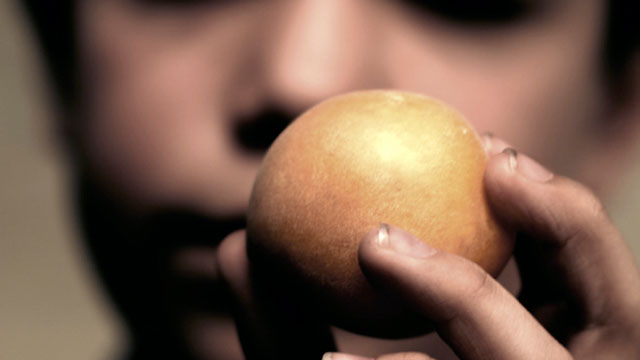
Simple yet impactful, Apricot moves you in an indescribable way while hitting the unconscious. The effect of the female character looking sideways and thinking of her first love with the sound of the guitar playing apparently far in the background makes one experience her daze though maintaining the enigma. Her eyes distant and thoughtful too, add to the effect of reminiscing. The far end of the sky is the first image of the memory, signifying the time that has gone by. Rainbow signifies happiness and surrealism whereas apricots portray the sensation of touch and smell that she remembers; the apricot, also, remind one of the sun that her first love stares at. There is a combination of the child eating an apricot and the man sipping on his coffee. As the moment of kissing comes close, we see how the child bit the apricot and kissed the girl. Similarly, the woman, back in reality sips on the coffee and kisses the man. Does Briand here talk about déjà vu? Or does he talk of the repetitiveness in the lives of human beings? In a way, he uses the regression of thoughts to show the similarity between the episodes in our lives. There is also a realization that the man in the film is empty without the remembrance of his past and the lack of memory is what makes him actually realize its importance. Or perhaps the girl, realising this, just pastes a memory in his mind? These are questions the director seems to have deliberately left for the audience to guess.
The background sounds in the movie is credited to Basil Hogios. Without the sound effects the movie would have failed to stir. Adam Arkapaw, the Director of Photography for ‘Apricot’ brings us images of the memories just as they would float in our minds. The simmering lights, the rainbow, the far end of the sky defining the length of time that has gone by, the feeling of apricots in their hands, the smell and so on. The music contributes in making one experience the characters’ feelings. Dialogues are vivid and poetic, and so smooth that they dissolve in the music- “He could stare at the sun longer than anyone I’d ever met,” says the woman about her first love. The music stops as the characters talk and re-starts when the memories appear. The only time when it plays in reality is the end as the characters kiss. Probably the film wants the viewers to see the dreamlike quality of the particular scene in the end the girl gifts the man fond and significant memories like one’s first love, one’s first kiss.
Still, one cant help but wonder whether she pasted a memory in his mind, if this memory belonged only to the girl or was the first love she talked about is the guy himself? Open ends takes the story further as each viewer perceives the picture according to her imagination; this is somehow a very involving experience.
It is hard for me to point out a flaw in this 10 min 39 second movie. The editing is marvellous, the story engaging and the camera work focused. The paint-like, hazy memories give it an overall fantastic feel. The other short films by this director talk about memory and identity as well. What does one make of oneself without a past or a memory? Memory loss leads to one of the most fundamental questions remaining unanswered- Where do I come from? ‘Castor and Pollux’ discuss the importance of common thoughts and mind reading in a relationship. On the other hand, ‘Some Static Started’ talks of Multiple Personality Disorder and Schizophrenia with a touch of horror. What’s common in these three films, besides mind problems and memory losses, is the brilliant acting; the actors completely immersed in the roles. But out of Briand’s three short films, I would recommend Apricot. The simple reason being its mere ‘simplicity’ and its ability to evoke forgotten memories. Apricot is a film for the dreamers, a film for the romantics and a film for film lovers.

No comments:
Post a Comment